


Straightening your teeth as an adult feels different than it would have at 14. You have client meetings, dinners out, daily responsibilities, and a budget that already has a job.
When comparing Invisalign vs braces for adults, the right choice often comes down to your orthodontic needs and how each treatment fits into your lifestyle.
Both options move teeth with steady, controlled pressure. For many mild-to-moderate cases, either approach may be effective, but the best choice depends on the type of tooth movement and bite correction you need.
With Invisaligns, you also need to be comfortable wearing your trays for the recommended number of hours each day.
Clear aligners give you a removable, discreet appliance that requires daily commitment. Braces stay fixed to your teeth, so treatment does not depend on remembering to put them back in after meals.
Adult orthodontic treatment is also more common than many people realize.
According to the American Association of Orthodontists, about one in three orthodontic patients is an adult, showing that choosing to straighten your teeth later in life is far from unusual.
Key Takeaways
- Aligners fit discreet, food-flexible lifestyles; fixed braces suit complex bites and low-compliance schedules.
- Costs overlap heavily, so your diagnosis and daily habits usually matter more than price.
- Both paths end the same way: retainers, for life, if you want results to hold.
Table of Content
- How Invisalign and Braces Move Adult Teeth
- Daily-Life Trade-Offs That Matter Most
- Effectiveness, Case Complexity, and Treatment Time
- Costs, Coverage, and Choosing the Right Provider
- Choose the Option You Can Follow Through With
- Frequently Asked Questions
How Invisalign and Braces Move Adult Teeth
Both systems apply gentle, sustained force to teeth so the bone around the roots remodels and the teeth shift into new positions.
The difference is how that force gets delivered and how much control your orthodontist has over each tooth.
How Clear Aligners Guide Tooth Movement
Invisalign treatment uses a series of custom clear plastic trays designed to gradually guide your teeth into new positions.
Each tray is shaped slightly differently, creating controlled pressure as you progress through treatment.
You wear each set for roughly one to two weeks, then swap to the next. Most treatment plans call for 20 to 22 hours of daily wear, which leaves about two hours for meals and brushing.
To handle trickier movements, small tooth-colored bumps called attachments get bonded to certain teeth.
They give the tray something to grip so it can rotate a canine or push a root in a specific direction. Tiny elastics or buttons sometimes get added for bite correction.
The trays are thin and nearly invisible at conversational distance. Most people will not notice them across a desk, though you may catch a slight lisp for the first few days.
How Brackets and Wires Create Controlled Movement
Traditional braces bond a bracket to each tooth and connect them with an archwire.
The wire wants to return to its original shape, and as it straightens, it carries your teeth with it.
Your orthodontist changes wires over the course of treatment, moving from flexible ones that handle rough alignment to stiffer rectangular wires that control root position and tipping.
Adults have options beyond metal brackets. Ceramic braces use tooth-colored brackets that blend in from a few feet away.
Lingual braces mount behind the teeth, so nothing shows from the front, though they take more getting used to and cost more.
| Feature | Invisalign | Metal Braces | Ceramic Braces |
| Visible from a few feet | Barely | Yes | Slightly |
| Removable | Yes | No | No |
| Food restrictions | None (trays out) | Several | Several |
| Depends on daily wear | Yes, 20-22 hrs | No | No |
| Typical adult cost | $4,500-$8,000 | $4,000-$7,000 | Upper end or above |

Daily-Life Trade-Offs That Matter Most
The clinical outcome is only half the decision. Aligners keep your appearance and diet mostly unchanged but hand you the responsibility, while braces take responsibility off your plate and put it into your food choices and your cleaning routine.
Visibility, Confidence, and Professional Appearance
If you present, teach, sell, or sit on camera all day, aligners are the discreet choice. Colleagues rarely notice them, and you can remove trays for a wedding photo or a big presentation.
Ceramic braces are a reasonable middle ground if aligner discipline worries you. They show, but far less than metal.
Lingual braces hide completely and suit adults who cannot tolerate any visible hardware.
Eating Out, Snacks, and Food Restrictions
Aligners have no food restrictions because you take them out to eat. That freedom comes with a catch: every snack costs you time, and grazers struggle to hit 22 hours.
Braces bring a real list. Popcorn, hard candy, nuts, ice, crusty bread, and sticky caramel can pop a bracket or bend a wire. Corn on the cob and apples need to be cut up first.
Oral Hygiene, Brushing, and Flossing
Brushing and flossing stay simple with aligners because you take the trays out and clean your teeth normally. Rinse the trays, brush them gently, and put them back.
Braces make hygiene the biggest daily commitment. Food packs around brackets, and plaque left along the gumline causes white spots and inflammation.
Plan on a threader or water flosser and a few extra minutes twice a day.
Comfort, Wear Time, and Patient Compliance
Both options feel tight and sore for a few days after each change, aligner swap or wire adjustment. Aligner pressure tends to be more even; braces can rub the inside of your cheeks until wax and time settle things.
Compliance is the real dividing line. Aligners work only when they are in your mouth, and adults who travel constantly or eat at their desks often underestimate that.
If you doubt you can keep trays in, fixed braces remove the question entirely. It helps to be honest with yourself before starting clear aligner treatment.
Effectiveness, Case Complexity, and Treatment Time
Modern aligners handle far more than they did a decade ago, and for mild-to-moderate crowding and spacing the two systems produce equivalent results.
Braces still hold an edge when treatment calls for large root movements, significant bite correction, or unusually precise control.
When Invisalign May Be a Strong Fit
Aligners can work well for many adults with mild-to-moderate crowding, gaps, or teeth that have shifted after previous orthodontic treatment.
Understanding whether Invisalign is right for you starts with evaluating your bite, tooth position, oral health, and ability to follow the recommended daily wear schedule.
Adults with gum recession, bone loss, or a history of periodontal disease may need their gum health evaluated before beginning orthodontic treatment.
Periodontic care can help address underlying gum problems before tooth movement begins.
When Fixed Braces Offer More Control
Severe crowding, large rotations, teeth that need to be moved bodily through bone, and significant overbite, underbite, or crossbite correction often go faster and more predictably with brackets and wires.
Cases involving jaw alignment surgery, impacted teeth, or coordination with implants and crowns also lean toward fixed appliances.
Braces stay put around the clock, so nothing depends on your memory.
What Actually Determines How Long Treatment Takes
Treatment time is driven by how far your teeth have to travel, how complex the movements are, your biology, and your consistency.
Most adult cases run somewhere between 12 and 24 months.
Neither system is reliably faster than the other for the same case. Aligner treatment stalls the moment wear time slips; braces slow down when brackets break repeatedly.
Both end with retainers, and that phase is permanent if you want the result to hold.
Costs, Coverage, and Choosing the Right Provider
Prices overlap so much that cost rarely settles the decision. What varies more is what a quoted fee includes and whether your case belongs with a specialist.
How Much Do Invisalign and Braces Cost for Adults?
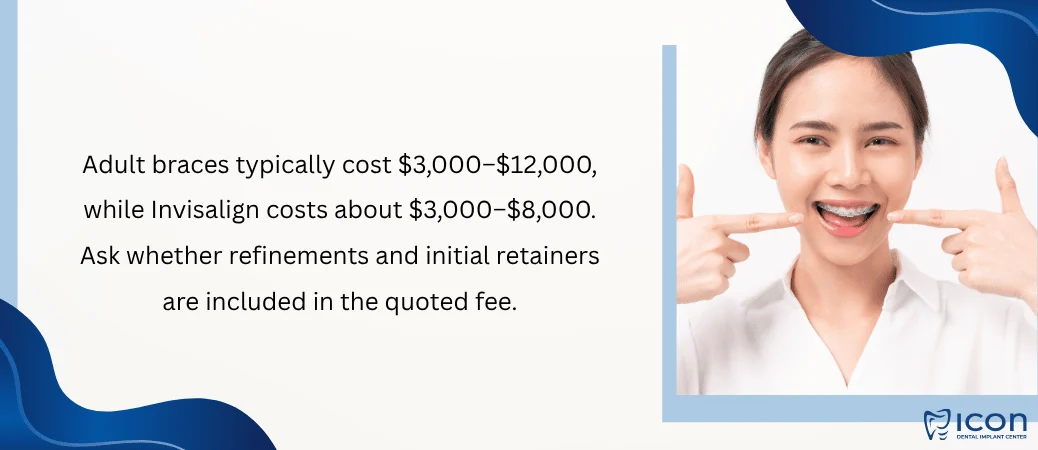
Traditional metal braces for adults run about $4,000 to $7,000, and Invisalign for adults falls between $4,500 and $8,000, though a broader survey of orthodontic pricing puts clear aligners closer to $3,000 to $8,000 and braces anywhere from $3,000 to $12,000 depending on complexity and region.
Ceramic braces sit at the top of the braces range or slightly above.
Ask what the quoted fee covers. Specifically: are refinement aligners included if teeth do not track perfectly, and is the first set of retainers part of the price or billed separately?
Dental Insurance and Flexible Payment Options
Dental insurance coverage for adult orthodontic treatment varies by plan, so it is important to review your specific benefits before starting treatment.
Your dental team can help you understand the estimated cost of care and what payment options may be available.
If paying the full cost upfront does not fit your budget, Icon Implant & Dental Center offers flexible financing options through CareCredit, Cherry, and Proceed Finance.
These options provide different monthly payment plans and financing terms, allowing you to explore a payment approach that works with your treatment needs and budget.
When to See an Orthodontist Rather Than a General Dentist
An orthodontist completes two to three years of specialized training in tooth movement and jaw alignment after dental school. General dentists handle mild aligner cases well, and small corrections often go smoothly.
See a specialist if you have a noticeable overbite, underbite, or crossbite; moderate to severe crowding or spacing; jaw pain, clicking, or trouble chewing; missing teeth that need coordination with other dental work; a case that relapsed significantly; or gum recession and bone loss that require careful force management.
Healthy teeth and gums come first either way. A professional teeth cleaning and exam can help identify cavities, gum inflammation, and other oral health concerns that may need attention before orthodontic treatment begins.
At Icon Implants and Dental Center, Dr. Radwa Elrefai and the dental team can evaluate your overall oral health and help determine the appropriate next step before you begin treatment.
Choose the Option You Can Follow Through With

Both systems straighten adult teeth well, and the gap between them is smaller than the marketing suggests.
Aligners reward discipline with discretion and dietary freedom. Braces trade appearance and food choices for a plan that runs without you.
Start with a diagnosis. Once an orthodontist maps the specific tooth movements your case needs, the shortlist usually narrows to one clear front-runner, and you can weigh Invisalign vs braces against your calendar and budget from there.
Bring real questions to the consultation: what the fee covers, whether refinements and retainers are included, how many hours of daily wear your plan assumes, and what happens if you fall short.
Whichever path you take, retainers are the last step and the one that protects everything you paid for.
Frequently Asked Questions
Is Invisalign better than braces for adults?
Neither is universally better. Aligners suit adults with mild-to-moderate crowding or spacing who prioritize appearance and can wear trays 20 to 22 hours daily, while braces handle complex bites and remove compliance from the equation. Your diagnosis decides more than the general comparison does.
Is Invisalign faster than braces for adults?
Not reliably. Most adult cases run 12 to 24 months with either system, and speed depends on how far teeth must move and how consistently you follow the plan.
Skipped aligner hours add weeks; broken brackets do the same.
Can Invisalign fix severe crowding and bite problems?
Aligners can address some bite issues with attachments and elastics, but severe crowding and significant overbite, underbite, or crossbite correction usually go more predictably with braces.
Cases needing large root movements or jaw surgery coordination lean fixed. An orthodontic exam will tell you which category yours falls into.
How much do Invisalign and braces cost with insurance?
Many plans cover $1,000 to $2,000 toward adult orthodontics as a lifetime benefit, applied against fees of roughly $4,000 to $8,000.
Coverage percentages and maximums vary widely by plan, so request a written benefits check before committing.
Why do some adults stop wearing Invisalign trays?
Wear time slips most often around frequent snacking, coffee habits, travel, and meetings where taking trays out feels awkward.
Each removal costs time, and two hours of allowance disappears fast. Adults who suspect this will happen do better with fixed braces.
Do adults need retainers after Invisalign or braces?
Yes, and indefinitely. Teeth drift throughout life, and adult relapse after teenage braces is one of the top reasons people return for treatment.
Most orthodontists start with nightly wear and taper to several nights a week long term.


