

You’ve probably heard dental implants cost anywhere from $1,500 to $6,000 per tooth and wondered why such a huge range exists.
The confusion gets worse when you receive different quotes from different dentists for what seems like the same procedure. You’re not getting the full picture because dental implants aren’t one single thing with one price.
A dental implant actually consists of three separate components (the implant screw that goes into your jawbone, the abutment connector piece, and the visible crown) each with its own cost that adds up to your total bill.
Your final price depends on which materials you choose, whether you need extra procedures like bone grafts, where you live, and who performs your surgery.
Some dentists quote only the implant screw cost while others include everything, which explains why comparing prices feels impossible.
This breakdown will show you exactly what you’re paying for with each component, which costs are necessary and which are optional, and where you can save money without compromising quality.
You’ll learn how to spot hidden fees, ask the right questions, and understand your quote before committing to treatment.
Key Takeaways
- Dental implants have three main parts with separate costs: the implant screw, abutment connector, and crown that add up to $1,800 to $3,000 per tooth
- Extra procedures like bone grafts, sinus lifts, and tooth extractions can add $500 to $2,000 or more to your total dental implant cost
- You can reduce costs by getting multiple quotes, choosing stock abutments for back teeth, and considering dental schools that offer 40-60% savings
Understand your dental implant cost breakdown and explore the best treatment options for your smile.
Table of Content
- Understanding the Components of a Dental Implant
- Types of Implant Treatments and Their Pricing
- Additional Procedures and Unexpected Costs
- Key Factors That Affect Dental Implant Pricing
- Ways to Make Dental Implants More Affordable
- Frequently Asked Questions
Understanding the Components of a Dental Implant
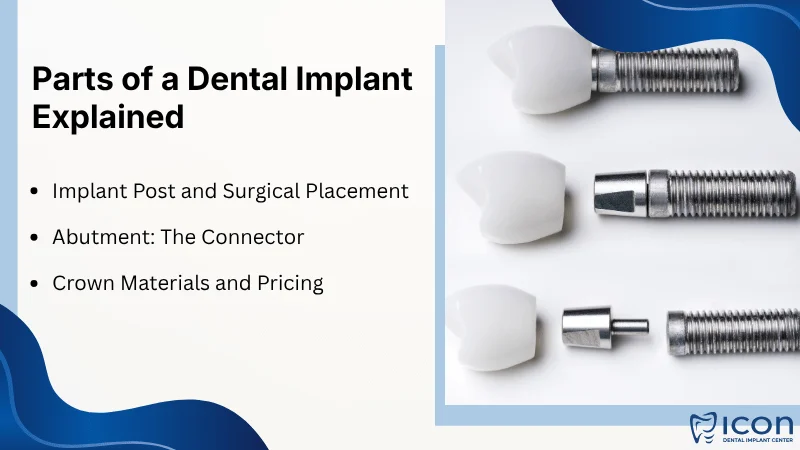
A single tooth dental implant cost breaks down into three main parts: the titanium post that goes into your jawbone, the abutment that connects everything together, and the crown you see when you smile.
Each piece has its own price tag and purpose in your restoration.
Implant Post and Surgical Placement
The implant post is a small titanium screw that acts as your new tooth root. This titanium implant gets surgically placed into your jawbone during a procedure that typically takes 1-2 hours per tooth.
Titanium implants are the most common choice because the metal bonds naturally with your bone through a process called osseointegration.
This fusion takes 3-6 months and gives your implant the strength to handle normal chewing pressure.
Some dentists now offer zirconia implants as a metal-free alternative, though these cost slightly more and have less long-term research behind them.
The implant placement surgery includes the surgical procedure itself, local anesthesia, and follow-up visits to check healing.
Implant post fees range from $1,000 to $3,000 depending on the brand used and your dentist’s experience level.
This part of the dental implant price is what you’ll see advertised in “$999 implant” promotions, but remember that’s just one piece of your total tooth implant cost.
Abutment: The Connector
The abutment is a small connector piece that attaches to the top of your implant post once osseointegration is complete. Your dentist screws or cements this component into place during a quick appointment.
Abutments come in different materials including titanium, zirconia, or gold alloy. The material choice depends on where the implant sits in your mouth and how much gum tissue will show when you smile.
Titanium abutments work well for back teeth, while zirconia creates a more natural look for front teeth since no gray metal shows through.
You’ll pay $400 to $1,000 for this component. Some dental implant cost breakdowns list the abutment separately, while others bundle it with the post or crown.
Always ask which components are included when comparing quotes.
Crown Materials and Pricing
The crown is the visible tooth-shaped cap that completes your implant. This is what you chew with and what others see in your smile.
Your material options include:
| Material | Crown Cost | Lifespan | Best For |
| Acrylic (PMMA) | $800 – $1,500 | 5-10 years | Temporary or budget restorations |
| Porcelain-Fused-to-Metal | $1,200 – $2,000 | 10-15 years | Back teeth needing durability |
| Zirconia (Monolithic) | $1,500 – $3,000 | 20-25+ years | Front teeth needing aesthetics |
A zirconia crown costs more upfront but resists staining better than porcelain and rarely chips or cracks. Porcelain-fused-to-metal crowns balance strength and appearance at a mid-range price.
Acrylic works for temporary situations but won’t hold up to heavy chewing long-term.
Your crown gets custom-made to match your other teeth in size, shape, and color. The dental implant prices you see advertised should include all three components to give you an accurate total.

Types of Implant Treatments and Their Pricing
The number of teeth you need to replace determines which implant treatment you’ll need and what you’ll pay.
A single dental implant costs $3,000 to $6,000, while full mouth restoration can reach $90,000 depending on the system used.
Single Tooth Implant Costs
A single tooth implant replaces one missing tooth with three parts: the titanium post, the abutment connector, and the crown on top.
The total single dental implant cost typically runs $3,000 to $5,600. This package usually includes all three components.
However, your actual bill might be higher. Tooth extraction adds $150 to $650 if the damaged tooth is still in place. Bone grafting costs $549 to $5,148 per site when you don’t have enough bone to support the implant.
CT scans, pre-op visits, and sedation are often billed separately too.
Your dentist bills this using CDT codes D6010 for the implant post, D6056 for the abutment, and D6058-D6065 for the crown.
Knowing these codes helps you verify what your insurance will cover before treatment starts.
Implant-Supported Bridge and Multi-Unit Costs
An implant-supported denture replaces two to four adjacent missing teeth using just two implants as anchors. The false teeth in the middle hang between the two implant posts, creating a fixed bridge that doesn’t come out.
This option costs $4,000 to $16,000 depending on how many teeth the bridge spans and what materials you choose.
CareCredit reports that most patients pay around $5,200 for a standard bridge.
Material choices affect your price:
- Porcelain-fused-to-metal (least expensive)
- Monolithic zirconia (mid-tier)
- Full ceramic (most expensive)
The trade-off with this approach is that the teeth in the middle aren’t directly anchored to your jawbone.
That means the bone underneath those false teeth will shrink over time, though the bridge itself stays firmly attached to the two implant posts.
Full Mouth Implants: All-on-4, All-on-6, and More
Full mouth implants replace all your teeth in one or both arches using different systems that balance cost, stability, and complexity.
All-on-4 uses four implants per arch to support a complete set of fixed teeth. The back two implants are angled to maximize contact with available bone, which often eliminates the need for bone grafting.
You’ll pay $11,640 to $27,500 per arch, with both arches typically costing $24,000 to $55,000 total.
3-on-6 places six implants per arch instead of four, distributing chewing pressure more evenly. This system costs $9,700 to $24,100 per arch. The extra implants mean higher upfront costs but better long-term stability.
Traditional full mouth reconstruction uses 8 to 14 implants per arch with individual crowns instead of a single fixed bridge.
This premium approach sits at the top of the price range, running $38,600 to $90,000 for both arches.
| Treatment Type | Price Range | Implants Used |
| All-on-4 (per arch) | $11,640–$27,500 | 4 per arch |
| 3-on-6 (per arch) | $9,700–$24,100 | 6 per arch |
| Full mouth (both arches) | $38,600–$90,000 | 16–28 total |
Some practices advertise “teeth in a day,” but not every case qualifies. You need enough initial bone stability for same-day provisional teeth to work.
Contact our Southfield, MI team to discuss implant costs, insurance coverage, and financing options.
Additional Procedures and Unexpected Costs
Beyond the core implant components, several preparatory and supportive procedures can add $500 to $8,500 to your dental implant cost breakdown.
These extras depend on your bone health, how many teeth need removal, and whether you need temporary teeth during healing.
Consultations, Imaging, and Pre-Treatment Assessments
Your journey starts with a consultation that costs $50 to $300. This visit includes an exam and treatment plan creation.
You’ll also need 3D CBCT imaging, which runs $100 to $350. This scan maps your bone density and nerve locations so your dentist can plan precise implant placement surgery.
Some practices bundle these costs into your total estimate, while others bill them separately.
Always ask for a pre-treatment estimate that lists every fee. This helps you avoid surprise charges later.
Bone Grafts and Sinus Lifts
If your jawbone is too thin or soft, you’ll need a bone graft before implant placement surgery can happen. Bone grafting costs range from $200 to $3,500 depending on how much bone needs rebuilding.
Upper back teeth sometimes sit too close to your sinus cavity. A sinus lift creates space for the implant and adds $1,500 to $5,000 to your tooth implant cost.
These procedures extend your timeline by three to six months. Your bone must heal completely before the titanium post gets placed. This healing period is called osseointegration.
Temporary Teeth and Follow-Up Visits
You might need temporary teeth while waiting for osseointegration to complete. These provisional prosthetics cost $1,000 to $3,000 and prevent gaps in your smile during the three to six month healing window.
If you need a tooth pulled before getting your implant, extractions add $150 to $450 per tooth. Sedation options like nitrous oxide or IV sedation cost another $200 to $800 if you want extra comfort during surgery.
Follow-up visits are usually included in your cost of dental implants, but confirm this upfront. Some practices charge separately for adjustment appointments or X-rays to monitor healing.
Key Factors That Affect Dental Implant Pricing
The material your dentist uses, their experience level, and the implant’s track record all directly impact what you’ll pay. These factors explain why quotes can range from $1,500 to $6,000 for the same procedure.
Material and Implant Brands
The implant brand and material you choose make up a big part of your total cost.
Budget brands like MIS and DENTSPLY cost $400-$600 per implant, while premium options like Straumann run $1,000-$1,200 and ultra-premium NobelBiocare can reach $1,200-$1,500.
Most implants use a titanium implant as the standard material. It’s proven, durable, and your bone fuses to it naturally.
Zirconia implants offer a metal-free alternative at similar or slightly higher prices, though they have less long-term research behind them.
The crown material also affects your bill. All-ceramic crowns cost $800-$1,500, zirconia runs $900-$1,400, and metal-fused ceramic comes in at $600-$1,000.
For back teeth, the cheaper options work fine. For front teeth where appearance matters, you’ll want to invest in better materials.
Premium brands often come with better warranties and decades of success data. Budget brands work well too, but you’re paying for less extensive research and track records.
Dentist’s Experience and Location
A general dentist charges $1,500-$2,500 per implant, while a periodontist (gum specialist) charges $2,000-$3,500.
Prosthodontists who focus on tooth replacement run $2,500-$4,000. Cosmetic specialists can charge $3,500-$6,000 or more.
Where you live changes dental implant prices significantly. Rural areas average $1,800-$2,200 per implant. Suburban locations run $2,200-$3,000.
Major cities like New York, Los Angeles, and San Francisco cost $2,800-$4,000 or more; that’s 30-50% higher than rural areas.
More experience doesn’t always mean better results. A general dentist who places 200 implants yearly may have better outcomes than a specialist who does 50. Ask how many implants they’ve placed and their success rate.
Implant Success Rate and Longevity
Understanding how long dental implants last helps you evaluate if the cost makes sense. The titanium screw typically lasts 20+ years. The abutment and crown need replacement every 10-15 years on average.
The implant success rate sits around 95-98% when placed by experienced dentists. Factors that affect success include your bone quality, whether you smoke, and if you have diabetes.
Failed implants need replacement at additional cost.
Higher-priced dentists sometimes justify their fees by pointing to better success rates. Ask for specific numbers; not just claims. A 98% success rate versus 95% might not justify paying double.
The real value comes from longevity. A $2,500 implant lasting 20 years costs you about $10 per month. That beats replacing a bridge every 10 years at $3,000 each time.
Ways to Make Dental Implants More Affordable
Several financing options can reduce the upfront cost of dental implants. Many dental offices offer flexible payment arrangements, and dental savings plans provide discounts that traditional insurance doesn’t cover.
Insurance Coverage for Implants
Most dental insurance plans treat implants as cosmetic procedures and don’t provide full coverage. However, some private insurance plans will partially cover certain parts of the procedure, like the crown or extraction.
You should check with your insurance provider to see what they cover. Medicare generally does not provide dental implant coverage, but Medicaid coverage varies by state.
If you have a flexible spending account (FSA) or health savings account (HSA), you can use these pre-tax dollars to pay for your implants. This reduces your overall cost by avoiding taxes on that money.
Some plans also cover the additional procedures needed before implant placement, such as bone grafting or tooth extractions.
Dental Discount and Savings Plans
Dental savings plans work differently than insurance. You pay an annual membership fee, usually between $100 and $200, and receive discounts of 10% to 60% on dental procedures at participating dentists.
These plans have no waiting periods or claim forms. You simply show your membership card and receive the discounted rate immediately.
Dental discount plans can be especially helpful if you need affordable dental implants and don’t have traditional insurance.
The savings can add up quickly on expensive procedures. A single implant that costs $4,000 might drop to $2,400 with a 40% discount through your dental savings plan.
In-House Payment Options and Financing
Many dental offices offer their own payment plans that let you spread costs over several months or years. These in-house payment plans often come with low or zero interest if you pay within a specific timeframe.
Third-party financing companies like CareCredit provide healthcare credit cards specifically for medical and dental expenses. 92% of patients use monthly financing options to make their implants affordable.
Some dentists offer cash discounts if you pay the full amount upfront with cash or debit card instead of credit. Ask your dental office about all available payment options before starting treatment.
Many providers will work with you to create a payment schedule that fits your budget.
Frequently Asked Questions
A dental implant quote can look confusing when you break down all the parts and procedures. Most people want to know what drives the total price up or down and whether their insurance will help cover any of it.
What’s typically included in the total price of a dental implant, and what parts are billed separately?
A complete dental implant has three main parts. The implant post is the titanium screw that goes into your jawbone and usually costs $1,000 to $2,000.
The abutment connects the post to the crown and runs $300 to $800. The crown is the visible tooth part and costs $900 to $2,500.
Some dentists give you one total price that includes all three parts. Others bill each component separately on your treatment plan.
Your quote might also list the initial exam, X-rays, or CT scans as separate line items. These imaging costs typically add $150 to $500.
Anesthesia or sedation during surgery may appear as another charge depending on what you need.
Why do some clinics advertise very low implant prices, and what extra fees might be added later?
You might see ads for implants priced at $999 or even lower. These advertised implant prices usually cover only the titanium post, not the abutment or crown.
The abutment and crown together can add $1,700 to $3,300 to that base price. You also need to factor in the exam, imaging, and any prep work like extractions or bone grafts.
Some clinics use low advertised prices to get you in the door. Once they evaluate your mouth, they may find you need additional procedures that weren’t mentioned in the ad.
Always ask for a complete written estimate that lists every procedure and component before you agree to treatment.
How much does a single-tooth dental implant usually cost with and without insurance?
Without insurance, a single dental implant typically costs $3,000 to $5,500 for the complete restoration. This includes the post, abutment, and crown in most cases.
Many dental insurance plans now cover implants as a major procedure. They usually pay about 50% of the cost up to your plan’s annual maximum. Most dental plans have annual maximums between $1,000 and $2,500.
If your insurance pays $1,500 toward a $4,500 implant, you would pay $3,000 out of pocket. Even with insurance, most people still pay $2,500 to $5,000 for a single implant after their benefits are applied.
Does dental insurance (including plans like Delta Dental) help pay for implants, crowns, or related procedures?
Dental insurance coverage for implants has gotten better in recent years. Many plans now classify implants as major restorative work and cover 50% of the cost.
Your annual maximum is the biggest factor in how much help you’ll actually get. If your plan maxes out at $1,500 per year and your implant costs $4,500, insurance will only cover the first $1,500.
Some plans have waiting periods for major procedures like implants. You might need to be enrolled for 6 to 12 months before implant coverage kicks in. Call your insurance company directly and ask for a pre-treatment estimate before you start any work.
What factors can increase the final cost, like bone grafting, sinus lifts, or 3D imaging?
Many patients need extra procedures before getting an implant. Bone grafting can add $250 to $3,000 to your total if your jawbone isn’t thick enough to support the implant.
A sinus lift costs $1,500 to $3,000 and is needed when placing upper back implants if your sinus cavity sits too low. Tooth extraction adds $150 to $650 per tooth if you still have a damaged tooth that needs to come out first.
CT scans or 3D imaging help your dentist plan the surgery precisely. These advanced scans cost $150 to $500 and aren’t always included in the base implant quote.
A temporary tooth or bridge to wear during healing can add another $500 to $1,500.
How much do full-mouth dental implants generally cost, and how does insurance affect the total?
Full-mouth dental implants range from $14,000 to $36,000 per arch. That means replacing all your upper or lower teeth. Both arches together can cost $25,000 to $70,000 or more depending on the technique used.
All-on-4 and All-on-6 are popular methods that use four to six implants to support a full arch of teeth. These cost less than placing individual implants for every missing tooth.
Insurance rarely covers the full cost of full-mouth implants. Most plans hit their annual maximum quickly, leaving you to pay most of the bill.
Some dental offices offer financing plans or work with companies like CareCredit to spread payments over 12 to 24 months.