

Full mouth reconstruction candidates often have several dental problems at once, including missing teeth, severely worn or broken teeth, gum disease, and changes in how their bite fits together.
However, only a comprehensive dental examination can determine whether this treatment is appropriate.
One cracked tooth or one gap rarely calls for a whole-mouth plan. A pattern of problems across both jaws is what points a dentist toward coordinated care.
You may benefit from full-mouth reconstruction if damage, disease, or extensive wear affects multiple teeth and individual repairs cannot adequately restore your oral health or chewing function.
A comprehensive dental examination is needed to determine the most appropriate treatment plan.
Reconstruction focuses on function and health first. A cosmetic makeover mainly changes how healthy teeth look, while reconstruction rebuilds teeth and bite so you can chew and speak with less strain.
Key Takeaways
- Overlapping problems across your mouth matter more than any single sign.
- Jaw pain or worn teeth alone do not prove you need a full rebuild.
- A complete exam of teeth, gums, bone, and bite is the true decision point.
Which Dental Problems Suggest You May Need a Comprehensive Plan?
Problems that spread across many teeth suggest a comprehensive plan, especially when they affect chewing.
Gaps from tooth loss, crowns that keep breaking, and loose teeth from gum disease each strain the teeth that remain, so they tend to show up together.
Multiple Missing Teeth or Difficulty Chewing
When you lose several teeth, the ones left behind take on more chewing work. Neighboring teeth can tip into the gaps, and opposing teeth can drift up or down.
These are some of the consequences of missing teeth that can gradually change how your bite fits together.
You may notice it first at meals. Maybe you chew only on one side, cut food into tiny pieces, or skip steak, raw vegetables, and nuts.
These habits are worth mentioning to your dentist because they show how much chewing function you have lost.
Gaps also affect the jaw itself. Understanding bone loss after tooth loss is important because the jawbone that once supported a missing tooth can gradually shrink without the stimulation it previously received.
Severely Damaged Teeth or Repeatedly Failing Restorations
Extensive tooth damage looks like cracks, deep decay, chipped edges, or teeth broken near the gumline. One damaged tooth is a repair job. A mouth full of them is a planning job.
Watch for a repeating cycle. If old fillings, crowns, or bridges keep cracking or falling out, the cause may sit outside the tooth being fixed.
An uneven bite or heavy grinding can keep breaking new work until the bigger issue is addressed.
Ask yourself a few honest questions:
- Have you had the same tooth repaired more than twice?
- Do you have dental work from many different years that is starting to fail?
- Are you patching one tooth while two others are waiting?
If you answered yes to several, your dentist may suggest looking at the whole mouth. Many plans still use familiar crowns and bridges, placed in an order that protects each one.
Advanced Gum Disease and Loose Teeth
Gum disease is a leading cause of tooth loss in adults, according to the National Institute of Dental and Craniofacial Research.
It starts as red, bleeding gums. Left alone, periodontal disease destroys the bone that anchors your teeth.
Signs of advanced periodontal disease include:
- Gums that pull back and make teeth look longer
- Teeth that feel loose or move when you bite
- New spaces opening between teeth
- Bad breath or a bad taste that will not go away
Managing active gum disease through periodontal care is generally an important step before proceeding with definitive restorative treatments such as crowns or replacement teeth.
When Do Tooth Wear and Bite Symptoms Matter?
Tooth wear and bite symptoms matter most when they come with damage you can see, such as flattened teeth or broken dental work. Alone, they are clues that need a closer look.

Worn Teeth from Grinding, Clenching, or Erosion
Worn teeth often look shorter, flatter, or see-through at the edges. Some people see small dents on chewing surfaces. Others notice their front teeth have become even across the bottom.
Several things cause this wear:
- Bruxism, meaning grinding, often during sleep
- Clenching, pressing your teeth hard together during stress or focus
- Erosion from acid, including frequent soda, citrus, or acid reflux
Your partner may hear you grinding at night before you notice anything. Morning jaw tiredness and new sensitivity to cold are also common.
Dentists assess the severity of tooth wear by examining the affected teeth, checking bite function, and reviewing possible causes such as grinding or acid erosion. These findings help determine whether monitoring, protective treatment, or restorative care is needed.
Mild tooth wear may only require monitoring or protective measures, such as a night guard when appropriate.
Severe wear affecting several teeth can alter bite function and may require coordinated restorative treatment. The extent of care depends on the cause and severity of the damage.
An Uneven Bite, Jaw Pain, or Chewing Discomfort
An uneven bite feels like your teeth do not close together the way they used to. One side may hit first. You might feel you have to hunt for a comfortable spot to bite down.
Jaw pain near your ears, clicking, headaches, or trouble opening wide can point to temporomandibular joint (TMJ) problems.
TMJ disorders have many possible causes, including muscle tension, stress, arthritis, and injury. Bite misalignment is only one possibility.
Why Symptoms Alone Cannot Establish Candidacy
Jaw pain does not prove you have a bite disorder. The NIDCR notes that TMJ disorders are complex, and many cases improve with simple, conservative care such as rest, soft foods, and self-care.
Rebuilding every tooth to fix jaw pain is a big step that a symptom alone cannot justify.
Worn teeth work the same way. Two people with similar wear may need very different care, depending on gum health, bone support, and how fast the wear is moving.
That is why the exam, and the records your dentist gathers, carry the decision.
How Does a Dentist Determine Whether You Are a Candidate?
A dentist decides by examining your whole mouth as one connected system, then comparing that picture with simpler options.
Records from teeth, gums, bone, and bite are weighed together, so a strong tooth next to a failing one still gets judged on its own future.
What a Comprehensive Dental Examination Checks
A comprehensive dental examination is longer and more detailed than a routine checkup. Expect it to cover:
| Area | What your dentist looks at |
| Teeth | Decay, cracks, wear, old dental work |
| Gums | Pocket depth, bleeding, recession, loose teeth |
| Jawbone | X-rays or 3D scans of bone height and width |
| Bite | How your teeth meet, bite height, jaw movement |
| Jaw joints and muscles | Tenderness, clicking, opening range |
| Health history | Medications, diabetes, smoking, past dental trauma |
Photos, impressions, or digital scans help map your bite. Bring a list of medications and any past dental records. Knowing your first visit expectations ahead of time can make the appointment feel calmer.
Complex cases may benefit from the expertise of a prosthodontist, a dentist with advanced training in restoring and replacing teeth.
At Icon Implants and Dental Center in Southfield, MI, Dr. Rami Elrefai brings specialized restorative training to the evaluation and planning of complex dental cases.
When Individual Repairs May Be Enough
Many people who worry they need a full rebuild turn out to need a few targeted repairs. If your gums are healthy, your bite is stable, and only a few teeth are affected, targeted repairs may be sufficient.
Your dentist can assess whether individual restorations will provide lasting function or whether a broader treatment plan is needed.
Dentists weigh each questionable tooth carefully. Research on deciding when to treat, extract, or replace a questionable tooth shows that a tooth’s long-term outlook depends on the whole plan around it, plus your home care and follow-up visits.
A good sign your dentist is being careful: they explain why a smaller plan would or would not hold up over time.
How Gum Health and Jawbone Support Affect the Plan
Gum disease has to be under control before most other work begins. New crowns on teeth in infected gums can fail early.
Jawbone volume and quality are important factors in dental implant planning. Patients with insufficient bone may need additional procedures, such as bone grafting, or may benefit from alternative tooth replacement options.
A detailed examination and imaging help determine which treatments are appropriate.
What Might a Reconstruction Plan Include?
A reconstruction plan combines several treatments, chosen for your mouth, in a set order. Every plan differs, and not every candidate needs implants.
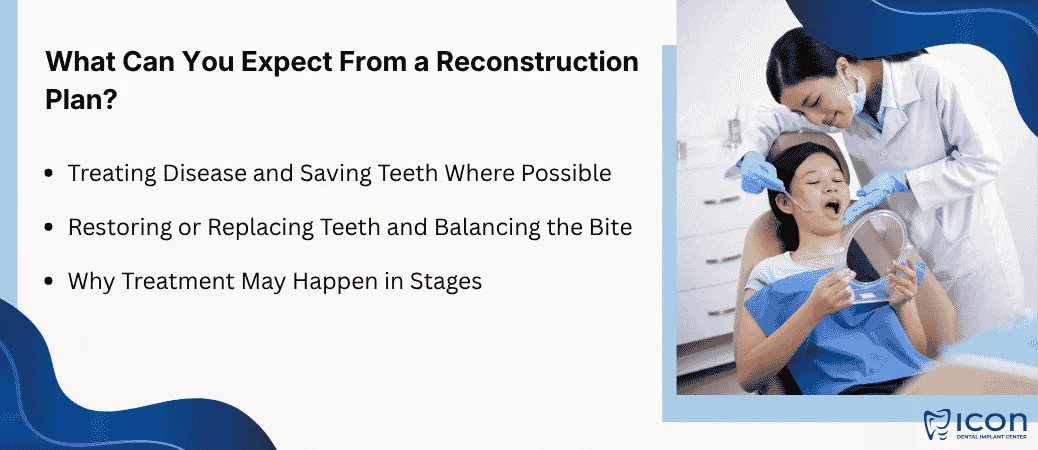
Treating Disease and Saving Teeth Where Possible
The first goal of comprehensive dental treatment is a healthy base. That may include:
- Periodontal treatment, such as deep cleaning or gum therapy to remove infection below the gumline
- Root canal therapy to save a tooth with an infected nerve
- Fillings for active decay
- Removing teeth that cannot be saved
Saving a natural tooth is worth the effort when it has a good outlook. Your dentist will tell you which teeth are strong enough to keep.
Restoring or Replacing Teeth and Balancing the Bite
Once disease is controlled, the rebuilding phase begins. Common tools include:
- Dental crowns to cover and protect weak or worn teeth
- Dental bridges to fill gaps using nearby teeth for support
- Dental implants, posts placed in the jaw that act like tooth roots
- Dentures, full or partial, for tooth replacement across a whole arch
- Orthodontics to move teeth into better positions before restoring them
- Porcelain veneers for front teeth, usually as a finishing step
Dental implants can replace missing teeth, while traditional dentures offer a removable alternative.
Understanding the differences between dental implants vs dentures can help you compare their benefits, maintenance needs, and long-term considerations.
For patients who want added stability with a removable restoration, implant-supported dentures may provide another option by attaching to implants placed in the jawbone.
Through all of this, your dentist balances the bite so chewing forces spread evenly across your teeth.
Why Treatment May Happen in Stages
Most plans move in phases. Disease control comes first, then rebuilding, then final crowns and bite fine-tuning. Bone grafts and implants need healing time before final teeth go on.
Staging also helps your budget and comfort. You can spread costs across months, and you can check that a temporary bite feels right before anything permanent is made.
Ask about financing options early so the plan fits your situation.
Choosing the Right Scope of Dental Care

The right scope of care matches the size of your problem. If missing teeth, gum disease, worn teeth, and bite changes overlap across your mouth, a full-mouth reconstruction plan can address them in the right order.
If only a few teeth are affected and your gums and bite are stable, smaller repairs make more sense.
Use the signs in this article as a starting checklist:
- Several gaps or loose teeth
- Dental work that keeps failing
- Flattened or shortened teeth
- Chewing that feels hard or uneven
Then bring that list to a full exam. Ask your dentist to explain the reason behind each recommendation, which teeth can be saved, and what a smaller plan would look like. Clear answers to those questions protect your oral health and your wallet.
Frequently Asked Questions
What does full mouth reconstruction mean?
It means rebuilding or restoring most or all of your teeth in both jaws through a coordinated plan. The plan can combine gum treatment, crowns, bridges, implants, dentures, or orthodontics. It focuses on chewing, comfort, and health first, with appearance improving along the way.
Can one missing tooth mean I need full mouth reconstruction?
No, one missing tooth almost never calls for a full rebuild on its own. An implant or bridge usually solves it. A dentist would only widen the plan if other problems, such as gum disease or heavy wear, are present too.
What could prevent me from getting dental implants?
Insufficient jawbone, active gum disease, smoking, certain medications, and poorly controlled medical conditions can affect dental implant eligibility.
Some concerns can be managed before treatment, while others may require a different approach. Your dentist will evaluate your oral and overall health before recommending implants.
How long does full mouth reconstruction take?
Many plans take several months, and complex cases can run a year or more. Healing after gum treatment, bone grafts, or implant placement adds the most time. Your dentist should give you a phase-by-phase timeline before you start.
Is full mouth reconstruction worth it?
It is worth it when overlapping problems keep you from chewing comfortably and repeated single repairs keep failing. It is a big commitment of time and money, so a careful exam and clear plan come first.