


Missing teeth affect more than just your smile. They make eating difficult, change how you speak, and can shake your confidence in social situations.
When teeth are gone, your jaw loses the stimulation it needs to stay strong, and nearby teeth can shift out of place.
Dental implants restore your natural bite strength by anchoring directly into your jawbone, giving you the stability and chewing power that dentures and bridges cannot match.
Unlike other tooth replacement options that rest on your gums or attach to neighboring teeth, dental implants work through a process called osseointegration, where the titanium post fuses with your bone to create a solid foundation.
This means you can eat the foods you love without worry and smile without fear of slipping or discomfort.
Beyond the physical benefits, implants help rebuild the confidence that often disappears with missing teeth. They look and feel like natural teeth, so you can laugh, talk, and enjoy meals without the constant worry that comes with removable dentures.
Key Takeaways
- Dental implants fuse directly with your jawbone to restore nearly full chewing power and prevent bone loss
- Implants last 15 to 25 years or more with proper care, outlasting dentures and bridges while protecting surrounding teeth
- Daily maintenance is simple with normal brushing and flossing, plus regular dental checkups to ensure long-term success
Learn how dental implants restore bite strength and improve daily comfort
Table of Content
- Why Missing Teeth Undermine Bite Strength and Oral Health
- How Dental Implants Restore Stability and Chewing Efficiency
- Preserving Jawbone Strength and Long-Term Oral Health
- Comparing Dental Implants to Other Tooth Replacement Options
- Everyday Lifestyle Benefits and Confidence Boosts
- Caring for Dental Implants and Ensuring Oral Health
- Frequently Asked Questions
Why Missing Teeth Undermine Bite Strength and Oral Health
When you lose a tooth, the effects go far beyond the visible gap in your smile.
Your jawbone begins to deteriorate without stimulation from tooth roots, while the remaining teeth shift out of position and your ability to chew properly decreases significantly.
Consequences of Tooth Loss for Chewing Power
Your natural teeth work together as a complete system to break down food efficiently. When you’re missing even one tooth, your chewing strength drops noticeably because the workload gets redistributed unevenly across your remaining teeth.
Missing teeth can cause problems with chewing, which leads to nutritional deficiencies when you start avoiding certain foods.
You might find yourself cutting out tougher foods like raw vegetables, nuts, or meats because they’ve become too difficult to eat comfortably.
The teeth adjacent to the gap take on extra pressure during chewing. This additional stress wears them down faster and can lead to further dental problems down the road.
Your bite force decreases with each missing tooth, making meals less enjoyable and more challenging.
Impact on Jawbone Health and Oral Function
Your jawbone needs constant stimulation from tooth roots to maintain its density and volume. When you lose a tooth, that area of bone no longer receives the pressure signals it needs during chewing.
This triggers a process called bone resorption where your body begins breaking down and absorbing the unused bone tissue.
The jawbone deterioration from missing teeth happens surprisingly fast. You can lose 25% of bone width in the first year after tooth loss.
This bone loss continues over time and changes the shape of your face, creating a sunken appearance around your mouth and jaw.
Common effects of jawbone deterioration include:
- Difficulty fitting dentures properly as your jaw shrinks
- Weakened support for surrounding teeth
- Changes in facial structure and appearance
- Reduced oral function for speaking and eating
How Tooth Loss Affects Bite Alignment
Your teeth naturally stay in position because they support each other. When you lose a tooth, the neighboring teeth start drifting into the empty space within months.
The teeth above or below the gap can also begin moving, erupting further than they should because they’ve lost their opposing partner.
This shifting creates bite issues and misalignment throughout your entire mouth. Your upper and lower teeth no longer fit together correctly when you close your jaw.
You might notice clicking sounds, jaw pain, or headaches as your bite becomes increasingly unbalanced.
The domino effect continues as more teeth shift out of place. This creates gaps where food gets trapped and makes proper oral hygiene harder to maintain.
Your risk of gum disease and additional tooth loss increases significantly when your bite alignment is compromised.
Schedule your consultation in Southfield, MI to restore chewing power with dental implants
How Dental Implants Restore Stability and Chewing Efficiency
Dental implants work differently than other tooth replacements because they anchor directly into your jawbone and function like natural teeth.
This design lets you regain your full chewing power and eat comfortably without worrying about shifting or slipping.

Mimicking Natural Tooth Roots
Your natural teeth stay strong because their roots extend deep into your jawbone. When you lose a tooth, you also lose that root structure, which affects both stability and bone health.
Dental implants restore bite strength by replacing the entire tooth, including the root portion beneath your gums. The titanium post serves as an artificial root that goes directly into your jaw during implant placement.
This root replacement does more than just hold your new tooth in place. It transfers pressure from chewing into your jawbone, just like your original teeth did. That stimulation helps maintain jawbone density over time.
Without this stimulation, your jaw starts to shrink after tooth loss. Implants prevent this by keeping your bone active and healthy.
The Role of Titanium Posts and Osseointegration
The titanium post is what makes dental implants so stable and long-lasting. Your body accepts titanium without rejecting it, which allows your bone to grow around the post naturally.
This bonding process is called osseointegration. Your jawbone actually fuses with the titanium posts over several months, creating a permanent connection that won’t come loose.
Osseointegration typically takes 8 to 16 weeks to complete. During this time, your bone cells grow directly onto the titanium surface and lock it firmly in place.
Once this fusion happens, your implant becomes as strong as a natural tooth root. You get a stable bite that can handle normal chewing force without any movement or discomfort.
Achieving a Stable Bite and Full Chewing Power
Traditional dentures only give you about 25% of your natural bite force. That’s why many denture wearers struggle with tougher foods like steak or raw vegetables.
Dental implants help restore proper chewing by providing nearly 100% of your original chewing efficiency. You can bite down with the same pressure you had before losing teeth.
This restored chewing force means you can eat all the foods you enjoy again. Crunchy apples, chewy bread, and tough meats become manageable without pain or hesitation.
Your implants distribute pressure evenly across your mouth when you chew. This balanced force protects your other teeth from extra wear and reduces strain on your jaw joints.
Differences from Removable Dentures

Removable dentures sit on top of your gums and rely on suction or adhesives to stay in place. They can slip when you talk or eat, which makes many people feel self-conscious.
Dental implants don’t move at all because they’re anchored in your jawbone. You never need messy adhesives or worry about embarrassing slipping during meals or conversations.
Traditional dentures also speed up bone loss because they don’t stimulate your jaw. Your bone continues to shrink, which means your dentures need frequent adjustments and eventual replacement.
Implants preserve your bone structure by providing the stimulation your jaw needs. They also don’t affect your other teeth, while bridges require grinding down healthy teeth for support.
Contact our Southfield, MI team to explore implant solutions that improve bite strength and comfort
Preserving Jawbone Strength and Long-Term Oral Health
When you lose a tooth, your jawbone begins to shrink without the root to keep it strong. Dental implants act like natural tooth roots and give your jaw the stimulation it needs to maintain bone density and support your facial structure.
How Implants Prevent Bone Loss
Your jawbone needs pressure from chewing to stay healthy. When a tooth goes missing, the bone underneath starts to break down because it no longer receives that stimulation.
Dental implants prevent bone loss by replacing the missing root. The titanium post fuses with your jawbone through a process called osseointegration.
Once this happens, the implant transfers chewing forces directly into the bone just like a natural tooth would.
This mechanical loading tells your body to keep the bone strong. Without it, bone resorption continues and you can lose up to 25% of bone width in the first year after losing a tooth.
Over time, this makes it harder to place implants later and can change how your face looks.
Benefits of preventing bone loss:
- Maintains jawbone strength and density
- Keeps your jaw ridge from shrinking
- Protects neighboring teeth from shifting
- Preserves your natural facial contours
Bone Grafting for Sufficient Bone Density
Sometimes you don’t have enough bone left to support an implant. This happens when bone resorption has already occurred or if you had an infection or injury.
Bone grafting adds material to rebuild your jaw so it can hold an implant securely.
During a bone graft procedure, your dentist places bone material in the weak area. This can be your own bone from another part of your body, donated bone, or synthetic material. The graft acts as a scaffold that encourages new bone growth.
You’ll need several months for the graft to heal before getting your implant. The wait ensures sufficient bone density for long-term success.
Ridge augmentation and socket preservation are common grafting techniques that help maintain jawbone health and prepare your mouth for permanent tooth replacement.
Supporting Facial Structure and Bite Function
Your jawbone does more than hold teeth. It shapes your lower face and supports your lips and cheeks. When bone resorbs, your face can look sunken or older than you are.
Implants preserve facial structure by maintaining bone volume where teeth used to be. This keeps your facial proportions balanced and prevents that collapsed look that can happen with dentures.
Healthy gums and strong bone also work together to support proper bite function. When your bite stays aligned, you distribute chewing pressure evenly across all your teeth.
This protects remaining teeth from excessive wear and reduces jaw pain or TMJ problems that can develop when your bite shifts.
Comparing Dental Implants to Other Tooth Replacement Options
When you’re choosing tooth replacement options, understanding the differences between implants, dentures, and bridges helps you make the right decision for your mouth and lifestyle.
Implants offer unique advantages in stability, bone preservation, and natural function that set them apart from other solutions.
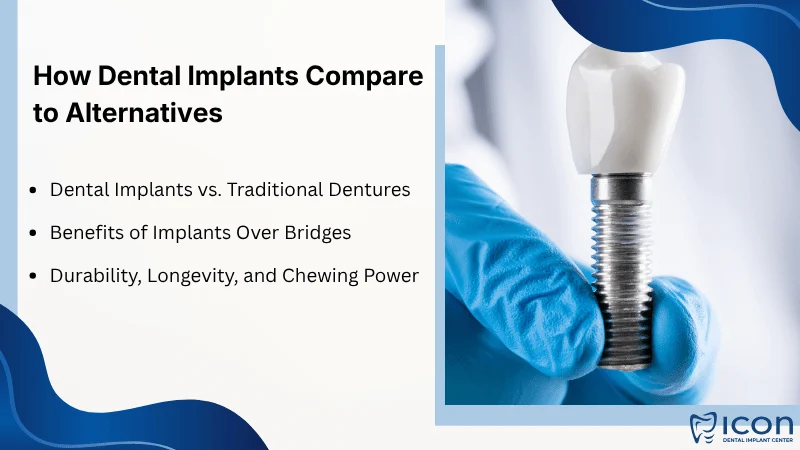
Dental Implants vs. Traditional Dentures
Traditional dentures sit on top of your gums and rely on suction or adhesives to stay in place. They’re removable and affordable, making them a popular choice for replacing multiple teeth.
However, unstable dentures can slip while you eat or talk, which causes embarrassment and discomfort. They also don’t stop the bone loss that happens after you lose teeth.
Over time, your jawbone shrinks, which makes your dentures fit poorly and require adjustments.
Dental implants work differently because they’re placed directly into your jawbone. This gives you a permanent foundation that doesn’t move or shift. You can eat, speak, and smile without worrying about your teeth slipping out of place.
Implants also stimulate your jawbone just like natural tooth roots do. This prevents bone deterioration and keeps your facial structure intact.
Comparing tooth replacement solutions shows that implants maintain your oral health better over time than removable dentures.
Benefits of Implants Over Bridges
Dental bridges use your neighboring teeth as anchors to hold a false tooth in place. Your dentist must grind down the healthy teeth on both sides of the gap to place crowns that support the bridge.
This process damages perfectly good teeth that didn’t need treatment. If those anchor teeth develop problems later, you could lose the entire bridge along with them.
Implants don’t require any changes to your surrounding teeth. Each implant stands independently in your jawbone without affecting neighboring teeth. This preserves more of your natural tooth structure.
Bridges typically last 10 to 15 years before needing replacement. They also don’t prevent bone loss under the missing tooth, which can create a depression in your gums over time.
Implants can last 20 years or longer with proper care, and many last a lifetime.
Durability, Longevity, and Chewing Power
When it comes to durability and longevity, implants outperform other tooth replacement options significantly.
The titanium posts fuse with your jawbone through a process called osseointegration, creating a stable base that can withstand normal chewing forces.
Your chewing power matters for enjoying the foods you love. Dentures reduce your bite strength to about 25% of what natural teeth provide. This makes it difficult to eat crunchy vegetables, meat, and other nutritious foods.
Implants restore up to 80-90% of your natural chewing power. You can bite into apples, chew steak, and eat corn on the cob without hesitation.
Key differences in longevity:
- Dentures: 5-8 years before replacement needed
- Bridges: 10-15 years average lifespan
- Implants: 20+ years, often lifetime with care
The higher upfront cost of implants pays off through their extended lifespan and minimal maintenance needs. You brush and floss them like regular teeth without special cleaning solutions or nightly removal routines.
Everyday Lifestyle Benefits and Confidence Boosts
Dental implants do more than just restore chewing strength. They bring back the natural appearance of your teeth and help you feel comfortable in social settings again.
Restoring Self-Esteem and Self-Confidence
Missing teeth can make you feel self-conscious about your appearance. You might cover your mouth when you laugh or avoid smiling in photos. Dental implants help restore your confidence and quality of life by giving you back a complete smile.
When you know your teeth look natural and function properly, you stop worrying about gaps or unstable dentures. You can speak clearly without worrying about slurred words or whistling sounds.
The stability of implants means you don’t have to stress about your teeth shifting or falling out at awkward moments.
Many people report feeling years younger after getting implants. Your self-confidence grows when you can eat, speak, and smile without thinking twice about your teeth.
Enjoying a Natural Appearance and Restored Smile

Dental implants are designed to blend seamlessly with your existing teeth. The custom-made crowns match the color, shape, and size of your natural teeth so no one can tell the difference.
Unlike dentures that can look artificial or create an unnatural bulge in your lips, implants sit in your jawbone just like real teeth.
This means your facial structure stays intact and you avoid the sunken appearance that often comes with tooth loss. Your restored smile helps you look like yourself again.
The natural appearance extends beyond just how your teeth look. Implants allow your lips and cheeks to maintain their normal position, preserving your facial contours and giving you a more youthful look.
Improved Social Life and Quality of Life
Your social life often suffers when you’re worried about your teeth. Dental implants let you enjoy meals with friends and family without worrying about what you can or cannot eat.
You can bite into an apple, enjoy corn on the cob, or savor a steak without discomfort.
Key social improvements include:
- Eating confidently at restaurants and social gatherings
- Speaking clearly during conversations and presentations
- Laughing freely without hiding your mouth
- Participating in activities without dental anxiety
The improved oral function you gain from implants helps you focus on enjoying experiences rather than managing dental problems. You stop avoiding certain foods or social situations because of your teeth.
This freedom significantly improves your overall quality of life and lets you participate fully in daily activities.
Caring for Dental Implants and Ensuring Oral Health
Dental implants need the same daily attention as natural teeth to stay healthy and functional for years. Proper brushing and flossing combined with regular professional care protects both your implants and the gums that support them.
Oral Hygiene Practices for Implants
Your dental implants require daily brushing and flossing just like your natural teeth. Use a soft-bristle toothbrush to clean around your implants twice a day.
Electric toothbrushes can be more effective if you have trouble with proper brushing movements.
Flossing between your implants and around the gum line removes food particles and bacteria that brushing alone can’t reach.
If you have multiple connected implants, you’ll need floss threaders or specialty floss with a built-in threading end to clean under your prosthetic teeth.
Some people find that yarn-like floss works well for cleaning under and around multiple implants.
Water picks can be a helpful addition to your cleaning routine. There are implant-specific water picks designed with features that make it easier to clean around your implants. You can use any toothpaste or mouth rinse you prefer with your implants.
Importance of Routine Dental Visits and Professional Cleanings
You need to visit your dentist regularly to check on your implants and maintain your oral health. Your dentist will examine your implants at each visit to confirm they’re securely attached and functioning properly.
Loose connections can damage the implant and cause bone loss around it.
Professional cleanings protect your implants from bacteria buildup. Your hygienist will use specialized instruments that won’t scratch the implant surface during cleaning.
Unlike natural teeth, dental implants don’t have periodontal pockets, so your hygienist won’t use the standard gum probe around them.
Your dental team will take X-rays during visits to check the bone supporting your implants. These radiographic evaluations are the best way to monitor bone health around your implants.
Multiple tooth implant appliances may need more frequent checkups than single implants.
Maintaining Healthy Gums Around Implants
Keeping your gums healthy is critical for implant success. While implants can’t get cavities, the gum tissue around them can develop inflammation called peri-implantitis.
This condition can lead to bone loss around your implants if left untreated.
Clean the gum line carefully where it meets your implants. Food and bacteria that collect at this junction can irritate the tissue and cause infection. Gentle daily cleaning prevents inflammation from developing.
Watch for warning signs like redness, swelling, or bleeding around your implants. These symptoms indicate that your gums need attention.
If you notice any changes in your gum tissue, contact your dentist right away. Proper maintenance of healthy gums ensures your implants stay stable and functional for many years.
Frequently Asked Questions
Dental implants raise many practical questions about strength, recovery time, and daily function. Understanding these details helps you make informed decisions about your oral health.
How do dental implants improve bite strength compared to dentures or bridges?
Dental implants anchor directly into your jawbone, which creates a stable foundation similar to natural tooth roots. This design allows dental implants to restore chewing strength more effectively than other options.
Traditional dentures rest on your gums and can slip or shift when you bite down. Bridges rely on neighboring teeth for support, which limits how much force they can handle.
Implants work with your jawbone to give you a reliable bite. While implant dentures may not fully match the bite force of natural teeth, they come surprisingly close.
How long does it take after implant placement before I can chew normally again?
The timeline for returning to normal chewing varies based on your specific procedure and healing process. Most people need to follow a modified diet for several weeks after surgery.
Your jawbone needs time to fuse with the implant in a process called osseointegration. This usually takes three to six months to complete fully.
During the early healing phase, you’ll need to stick with soft foods. Your dentist will guide you through gradual stages of reintroducing harder foods as healing progresses.
Will dental implants feel and function like natural teeth when eating and speaking?
Dental implants look and feel like your natural teeth with no visible difference. You can expect them to function normally once healing is complete.
The implant becomes part of your jaw structure, which means it responds to pressure just like a natural tooth root. This allows you to bite and chew without worrying about movement or instability.
Speaking feels natural because implants don’t shift or click like dentures can. You won’t need to adjust how you form words or sounds.
What foods can I eat during recovery, and when can I return to a regular diet?
Right after surgery, stick with soft foods that require minimal chewing. Good options include yogurt, smoothies, mashed potatoes, and scrambled eggs.
You can add slightly firmer foods after the first week, like pasta, cooked vegetables, and soft fish. Avoid crunchy, sticky, or hard foods during the initial healing period.
Most people can return to eating most regular foods within a few weeks. Your dentist will let you know when your implant has healed enough for you to resume your normal diet completely.
How durable are dental implants for everyday chewing, and what affects their lifespan?
With proper care and oral hygiene, implants can last many years and often provide long-term stability. Many implants last 20 years or longer with good maintenance.
Your daily habits play a big role in how long your implants last. Regular brushing, flossing, and dental checkups help prevent infections around the implant.
Smoking can reduce implant success rates and shorten their lifespan. Grinding your teeth at night may also put extra stress on implants, so your dentist might recommend a night guard.
Who is a good candidate for dental implants, and what if I have bone loss?
Most adults with healthy gums and sufficient bone density are good candidates for dental implants. A dental evaluation can confirm whether implants are right for you.
If you have bone loss from missing teeth or gum disease, you may still qualify for implants. Bone grafting procedures can rebuild your jawbone to create enough density for successful implant placement.
Your overall health matters too. Conditions like uncontrolled diabetes or certain medications may affect healing, but many people with health conditions can still get implants with proper planning and care.


